
Mastering Incident-To Billing in Mental Health
MEDICAL BILLING
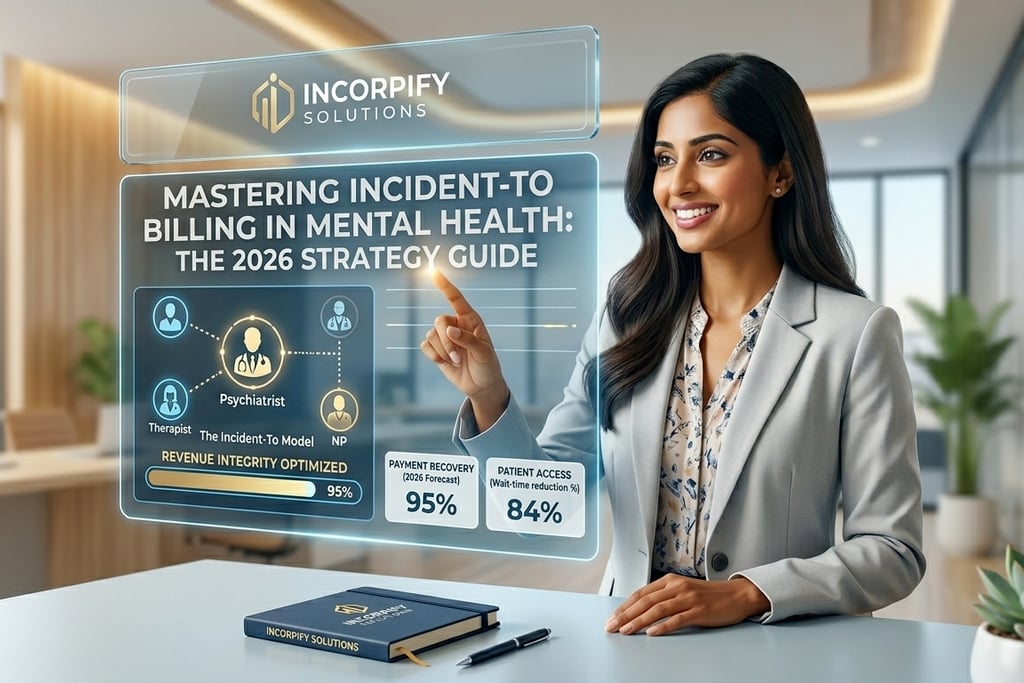
Mastering Incident-To Billing in Mental Health The 2026 Strategy Guide
Medicare billing remains one of the most significant administrative hurdles for psychiatry and behavioral health practices. Central to this complexity is the "Incident-To" billing policy. While many providers are aware of its existence, few have optimized it to support a sustainable revenue cycle.
In 2026, Incident-To billing is no longer just a way to save time; it is a vital mechanism for expanding patient access and maintaining 100% physician-level reimbursement in an era of tightening margins.
What Is Incident-To Billing in 2026?
Incident-To billing allows a practice to bill Medicare at 100% of the physician fee schedule rate, even when the service is performed by non-physician "auxiliary personnel" (such as a Nurse Practitioner, Physician Assistant, or Licensed Therapist).
How the Workflow Operates:
Initial Encounter: A Medicare-recognized billing practitioner (typically a psychiatrist) performs the initial visit, establishes the diagnosis, and creates the treatment plan.
Follow-Up Care: A qualified team member provides subsequent care that is an integral part of that established plan.
Submission: The claim is submitted under the supervising physician’s NPI rather than the individual who performed the visit.
Key 2026 Update: While Nurse Practitioners (NPs) and Physician Assistants (PAs) can bill under their own NPI, doing so usually triggers a 15% payment reduction (reimbursement at 85%). Correct Incident-To usage captures that missing 15%, which is often the difference between a clinic’s profit and loss.
Critical Rules for Compliance in 2026
Medicare has refined its parameters to ensure quality of care while offering more flexibility for mental health settings.
1. The "Established Plan" Requirement
Incident-To applies only to follow-up visits. If a patient presents with a new mental health issue or requires a significant change in the treatment plan, the supervising physician must see the patient again to document and update the plan before Incident-To billing can resume.
2. Supervision: General vs. Virtual Direct
In 2026, the definition of "supervision" has become more flexible for behavioral health:
General Supervision: For most mental health services, the billing clinician must oversee the care and be available for assistance, but physical presence in the office suite is not required.
Virtual Direct Supervision: Effective January 1, 2026, CMS has permanently adopted the policy allowing "direct supervision" to be satisfied via real-time audio and video technology. The supervisor can be "virtually present" from a remote location to oversee specific high-risk services.
3. Setting Restrictions
Incident-To billing is strictly for office-based or outpatient clinic settings (Place of Service 11). It cannot be used for services provided to patients in a hospital or a skilled nursing facility (SNF) under Medicare Part B rules.
Why This Matters for Mental Health Specialties
With the mental health crisis continuing into 2026, practices are stretched thin. Incident-To billing provides a "Pragmatic Solution for Sustainability":
Increased Access: Psychiatrists can focus on complex diagnostic work and medication management for new patients while delegating routine psychotherapy and follow-up to licensed staff.
Economic Stability: Collecting 100% of the physician rate covers the rising costs of clinical labor and administrative overhead.
Seamless Telehealth: The permanent extension of virtual supervision allows clinics to leverage a hybrid workforce, keeping your team efficient even if the supervisor is working remotely.
Common Incident-To Pitfalls to Avoid
The "New Problem" Trap: Billing a visit as Incident-To when the patient has a brand-new diagnosis that the physician hasn't reviewed yet.
Documentation Gaps: Failing to link the auxiliary personnel's notes back to the physician's original treatment plan.
Solo-Practitioner Errors: Thinking you can bill Incident-To for a pre-licensed trainee. Medicare Part B generally does not reimburse for pre-licensed associates in private practice settings.
Maximize Your Revenue with Incorpify Solutions
Managing the nuances of 42 CFR 410.26 (the Incident-To regulation) requires precision and constant auditing. Incorpify Solutions provides specialized RCM services for mental health practices, ensuring you capture every dollar earned while maintaining 100% audit-ready documentation.
Don't leave 15% of your revenue on the table. Contact Incorpify Solutions today for a consultation on optimizing your psychiatry or behavioral health billing.


Empowering American healthcare providers with expert, HIPAA-compliant billing and credentialing. We transform complex RCM into a streamlined engine for growth, delivering unmatched accuracy and maximized reimbursements


© 2026 Incorpify Solutions, LLC. All rights reserved | Privacy Policy
Contact
Address: PHOENIX, AZ 85016
Email: info@incorpify.pro
Phone: 915-250-0984